Breaking the Aromaticity Trap: N-Silylation-Induced Formation of Stable 2,3-Dihydro-4-dialkylaminopyridin-1-iums
Jun 26, 2026·


Valerii Verkhov
Artyom Yakubenko
Benjamin Begović
Prof. Elena Tupikina
Dr. Alexander Antonov
Corresponding author
·
0 min read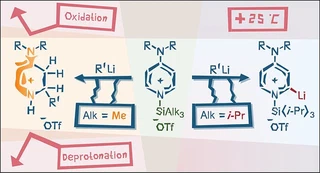
Abstract
The reactivity of pyridines toward organolithium reagents is dominated by the nucleophilic addition to the C2 position, leading to the formation of labile 1,2-dihydropyridines that readily rearomatize. Herein, we report an unexpected deviation from this classical pathway. Trimethylsilylation of 4-dialkylaminopyridine steers their reaction with alkyl lithium reagents (n-BuLi, s-BuLi, t-BuLi) toward the formation of 2,3-dihydro-4-dialkylaminopyridin-1-iums, isolated as air-stable triflates, which are remarkably resistant to oxidation and deprotonation. This stability is attributed to pronounced orbital interactions and charge delocalization between the NR2 group and the pyridinium core creating a vinylogous amidine structural motif. At the same time, triisopropylsilylation completely suppresses nucleophilic addition, enabling the first case of room-temperature C2 lithiation of the pyridine core. This difference in the reaction pathway originated from a dramatic decrease of the relative steric accessibility of C2(6) pyridine carbon atoms.
Publication
J. Org. Chem. 2026, doi: 10.1021/acs.joc.6c00105


