Hydrogen-Bond-Assisted Configurational Diversity of Benzamidines: Experimental and Theoretical Study
Jan 27, 2026· ,
,


Edem R. Chakalov
Dr. Daria Tonkoglazova
Anna A. Titova
Maxim Kruglov
Prof. Elena Tupikina
Corresponding author
Dr. Alexander Antonov
Corresponding author
Prof. Peter Tolstoy
Corresponding author
·
0 min read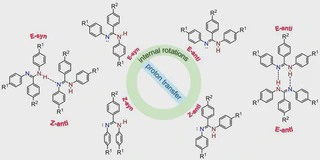
Abstract
Configurational diversity and mechanisms of prototropic tautomerism of 15 N,N’-diarylbenzamidines as potential building blocks in H-bonded polymeric materials are investigated. Variable-temperature 1D and 2D liquid-state NMR spectroscopic studies provide strong evidence of the solvent-dependent dynamic interconversion between all four isomers, E-anti, E-syn, Z-anti and Z-syn. Some of the isomers are prone to either a linear or a cyclic dimerization through H-bonding. A quantitative assessment of the changes in proton-donating ability of the amine functionality depending on electron-donating ability of para-substituents in all three aryl rings of N,N’-diarylbenzamidines is proposed based on the 1H NMR data and Hammett’s substituents constants. A different pattern of the ordered H-bonded network composed exclusively of non-planar E-syn isomers is observed in the solid state by X-ray diffraction studies. DFT calculations confirm the torsional flexibility of the molecules, which are able to closely approach each other and form various linear and cyclic dimers, for which the relative stability is determined by the interplay of NH···N hydrogen bonding and π-π stacking interactions. Rotational barrier calculations offer mechanistic insights into the tautomerization and conformational dynamics observed in the NMR spectra.
Publication
Org. Chem. Front., 2026, doi: D5QO01450F


