Hydrogen-bond-assisted Chalcogen Transfer Between Phosphine Selenides and Arsine Oxides
May 5, 2025·


D. V. Krutin
Dr. Semyon Tsybulin
Prof. Elena Tupikina
Prof. Peter Tolstoy
Dr. Alexander Antonov
Corresponding author
·
0 min read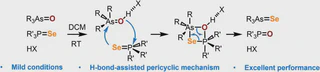
Abstract
The Brønsted acid catalysis is widely regarded as one of the most effective methods for activating inert substrates and enabling unique reactivity. In this work, we introduce the first example of H-bond-assisted chalcogen exchange between arsine oxides and phosphine selenides under mild conditions, providing a powerful approach to the synthesis of arsine selenides. The reaction proceeds successfully in both protic and aprotic solvents and is accelerated by the presence of any nonaqueous acid. This newly discovered reaction is tested for various arsine oxides R3AsO (R = Ph, Et, nBu, iPr) and phosphine selenides R3PSe (R = Ph, Me, Et, tBu) and overall demonstrates high conversion, although the use of reagents with bulky substituents significantly hinders its efficiency. The reaction mechanism involves the formation of a four-membered cyclic transition state, which requires overcoming steric and electrostatic repulsion, as well as significant distortion of the reagents’ tetrahedral geometry. Hydrogen bonding with the As═O fragment helps to reduce electrostatic repulsion between the P═Se and As═O groups, making the formation of the cyclic intermediate more favorable.
Publication
Inorg. Chem., 2025, 64, 19, 9447–9456


