Chiral Diselenophosphoric Acids for Ion Pair Catalysis: A Novel Approach to Enhance Both Proton Donating and Proton Accepting Properties
May 15, 2024·


J. Eder
Dr. Alexander Antonov
Prof. Elena Tupikina
Prof. Ruth Gschwind
Corresponding author
·
0 min read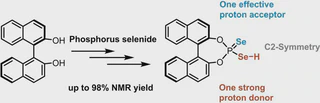
Abstract
The activation of poorly reactive substrates via strong chiral acids is a central topic in asymmetric ion pair catalysis these days. Despite highly successful scaffolds such as N-triflylphosphoramides, these catalysts either lack C2-symmetry or provide multiple H-bond acceptor sites, leading to lower ee values for certain reactions. We present BINOL-based diselenophosphoric acids (DSA) as an extremely promising alternative. Using an intertwined approach of synthesis and NMR studies, we developed a synthetic approach to DSA with up to 98 % NMR yield. The obtained acids provide both very high proton donor and proton acceptor properties, a bifunctionality, which is key to catalytic applications. Indeed, first reactivity test proved the much higher acidity of DSA and its ability to initiate Mukaiyama–Mannich reaction and protodesilylation of silyl ethers. Together with their C2-symmetry, the single donor and single acceptor situation, the decreased tendency of self-association, and the straightforward synthesis with potential 3,3’-substitution, the DSA provide all features ideal for the further development of ion pair catalysis.
Publication
Chem. Eur. J. 2024, 30, e202401793.


