Proton-induced fluorescence in modified quino[7,8-h]quinolines: dual sensing for protons and π-donors
Oct 24, 2019· ,,,
,,, ·
0 min read
·
0 min read
Prof. Alexander Pozharskii
Corresponding author
,V. A. Ozeryanskii
V. Y. Mikshiev
A. V. Chernyshev
A. V. Metelitsa
Dr. Alexander Antonov
Abstract
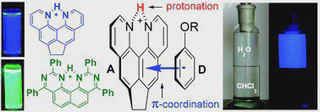
The synthesis, as well as spectral, structural and photoluminescence properties of dipyrido[3,2-e:2′,3′-h]acenaphthene 5 and quinazolino[7,8-h]quinazolines 6 as representatives of the bidentate –N[double bond, length as m-dash]/–N[double bond, length as m-dash] superbases, are reported. These nitrogen bases being more rigid (5) or π-extended (6) analogs of optically-mute quino[7,8-h]quinoline are both active in terms of fluorescence with quantum yields up to ϕ = 0.71–0.77. At the same time, their luminescence behavior is opposite to that of peri-NMe2/NMe2 naphthalene proton sponges and their hybrid NMe2/–N[double bond, length as m-dash] analogs. Although 5 and 6 exhibit visible region emission upon protonation, for the hybrid systems the fluorescence is manifested only for bases. The most remarkable observation is that the fluorescence of compound 5 can be switched on not only by means of organic or inorganic acids, but also through the formation of chelate complexes with such weak H-donors as water and primary alcohols. It was disclosed that water is present in the complex as a cluster comprising 8 interconnected H2O molecules. Overall, the studied compounds demonstrate a previously unobserved type of dual mode optical response, H-sensing (emission enhancement in 5 and 6 on protonation) and π-sensing (emission quenching in 5H+ and 6H+ on coordination with π-donors). This work seems to be an important contribution to areas such as chemosensorics, the creation of new ligands, hydrogen transfer and some other phenomena representing different types of supramolecular interactions.
Publication
Org. Biomol. Chem. 2019, 17, 8221–8233

Authors
1938-2025
Prof. Pozharskii was not only my PhD supervisor, but he was a beacon in the scientific world for me. He taught me how to properly plan an experiment, how to write research papers, how to supervise students, how to make grant applications, and how to give lectures. I am who I am today thanks to Prof. Pozharskii and his contribution to me.
Authors
Authors
Authors
Authors
