Reaction of 2-Trifluoroacetyl-1,8-Bis(dimethylamino)naphthalene with Strong Organic Bases: Acidic Ionization of 1-NMe2 Group Resulting in the Formation of Benzo[g]indole Derivatives versus Nucleophilic Addition to C=O Group
May 8, 2017·
 ,,·
0 min read
,,·
0 min read
Dr. Alexander Antonov
Corresponding author
,Kachalkina
Prof. Alexander Pozharskii
G. S. Borodkin
A. Filarowski
Abstract
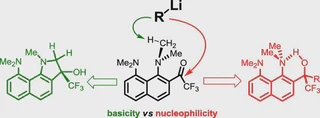
A novel approach to pyrrole ring closure in 2-trifluoroacetyl- and 2-ethoxycarbonyl-1,8-bis(dimethylamino)naphthalenes via treatment with 2-lithium-1,8-bis(dimethylamino)naphthalene producing the corresponding benzo[g]indole derivatives, was examined with different alkyl- and aryllithium compounds as well as with LDA. It was found that the highest yields of benzo[g]indoles (up to 70%) are obtained with aryllithium reagents when they contain NMe2 group in ortho-position to the carbanionic centre. In all other cases the formation of acyclic alcohol arising from ordinary intermolecular addition of the carbanion to the Cdouble bondO group strongly prevails. The dramatic facilitation of deprotonation of the N-Me group in substrate followed by pyrrolic cyclization in the case of 2-lithium-N,N-dimethylanilines was explained through a specific structure of the reaction transition state.
Publication
Tetrahedron 2017, 73, 3452–3457

Authors

Authors
1938-2025
Prof. Pozharskii was not only my PhD supervisor, but he was a beacon in the scientific world for me. He taught me how to properly plan an experiment, how to write research papers, how to supervise students, how to make grant applications, and how to give lectures. I am who I am today thanks to Prof. Pozharskii and his contribution to me.
Authors
Authors