10-Dimethylamino derivatives of benzo[h]quinoline and benzo[h]quinazolines: fluorescent proton sponge analogues with opposed peri-NMe2/–N= groups. How to distinguish between proton sponges and pseudo-proton sponges
Jun 10, 2016· ,
, ,,,,,·
0 min read
,,,,,·
0 min read
Prof. Alexander Pozharskii
Corresponding author
,V. A. Ozeryanskii
V. Y. Mikshiev
Dr. Alexander Antonov
A. V. Chernyshev
A. V. Metelitsa
G. S. Borodkin
N. S. Fedik
O. V. Dyablo
Abstract
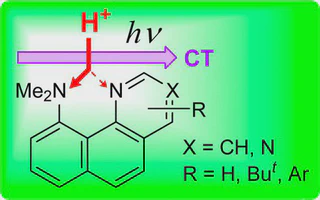
For the first time, 10-dimethylamino derivatives of benzo[h]quinoline 6 and benzo[h]quinazoline 7a–e as mixed analogues of archetypal 1,8-bis(dimethylamino)naphthalene (“proton sponge”) 1 and quino[7,8-h]quinoline 2a have been examined. Similar to 1 and 2, compounds 6 and 7 display rather high basicity, forming chelated monocations. At the same time, unexpected specifics of the protonated NMe2/—N═ systems consist of a strong shift of the NH proton to the 10-NMe2 group, contrary to the “aniline–pyridine” basicity rule. In case of 4H+, a rapid migration (in the NMR time scale) of the NH proton between two nitrogen atoms along the N–H···N hydrogen bond was registered at room temperature and frozen below −30 °C with the proton fixed on the NMe2 group. Two different approaches for classification of strong neutral nitrogen organic bases as proton sponges (kinetically inert compounds) or pseudo-proton sponges (kinetically active) are discussed. On this basis, benzoquinoline 6 was identified as staying closer to pseudo-proton sponges while 7a–e to proton sponges due to the presence in their molecules of bulky substituents in the pyrimidine ring. Other remarkable peculiarities of 6 and 7 are their yellow color and luminescence in the visible region distinguishing them from colorless 1 and 2a.
Publication
J. Org. Chem. 2016, 81, 5574–5587

Authors
1938-2025
Prof. Pozharskii was not only my PhD supervisor, but he was a beacon in the scientific world for me. He taught me how to properly plan an experiment, how to write research papers, how to supervise students, how to make grant applications, and how to give lectures. I am who I am today thanks to Prof. Pozharskii and his contribution to me.
Authors
Authors

Authors
Authors
Authors
Authors
Authors