Out-Basicity of 1,8-bis(dimethylamino)naphthalene: The experimental and theoretical challenge
Dec 20, 2013·
 ,·
0 min read
,·
0 min read
V. A. Ozeryanskii
Prof. Alexander Pozharskii
Corresponding author
Dr. Alexander Antonov
A. Filarowski
Abstract
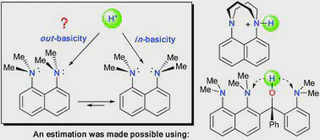
A possibility of non-conventional two-step protonation of 1,8-bis(dimethylamino)naphthalene (proton sponge) is discussed. Unlike the generally accepted mechanism, involving relatively slow direct penetration of a proton into the cleft between the peri-NMe2 groups, it consists of the rapid addition of a proton to the out-inverted NMe2 group with the subsequent slower rotational transfer of the proton into the inter-nitrogen space to produce a stable chelated cation. The following approaches were employed during the work: (1) competitive hydrogen bond formation in a specially designed alcohol in which the OH group might chelate either the proton sponge 1-NMe2 group or another basic center (N,N-dimethylaniline) of known basicity; (2) measuring the basicity of naphtho[1,8-b,c]diazabicyclo[3.3.3]undecane considered to be a close analogue of the proton sponge capable exclusively of out-protonation; (3) X-ray, spectral and DFT studies of structure, energy and stereodynamics of compounds obtained, including their conformers. For the first time, the pKa value of an organic base with a perfectly flat nitrogen atom is reported. The final conclusion is made that both pathways of proton sponge protonation, traditional and non-conventional, contribute in parallel with a still undefined ratio. The estimated out-basicity of the proton sponge is at least 5.5 orders of magnitude lower than the directly measured in-basicity.
Publication
Org. Biomol. Chem. 2014, 12, 2360–2369
Authors

Authors
1938-2025
Prof. Pozharskii was not only my PhD supervisor, but he was a beacon in the scientific world for me. He taught me how to properly plan an experiment, how to write research papers, how to supervise students, how to make grant applications, and how to give lectures. I am who I am today thanks to Prof. Pozharskii and his contribution to me.

Authors